Analyzing a Lennard-Jones fluid
This example will analyze a dump file from a simulation of simple liquid that interacts via the Lennard-Jones pair potential:
We’ve included the LAMMPS input file if you want to run the simulation yourself, but we’ve also included the dump file that we generated if you want to continue along now!
First, we import lammpsio.
[13]:
import lammpsio
Dump files offer users flexibility in choosing what information to log, which can make processing these files challenging. Luckily, lammpsio will infer the format automatically! Alternatively, you can manually specify the schema when reading the file. lammpsio can even load in a trajectory that has been written in gzip’s compressed format!
[14]:
dump_file = lammpsio.DumpFile("traj.lammpstrj.gz")
Calculating the radial distribution function
We will use the freud package to calculate the radial distribution function, \(g(r)\), for our Lennard-Jones fluid. Before continuing, make sure you have both freud and matplotlib installed. While freud does not natively read LAMMPS files, it accepts particle coordinates as NumPy arrays. lammpsio makes it easy to extract this data from LAMMPS dump files!
We will evaluate \(g(r)\) out to a distance of \(3\,\sigma\) using a bin spacing of \(0.1\,\sigma\). freud assumes HOOMD-blue’s convention for its box which differs slightly from LAMMPS. lammpsio can take care of this conversion for you!
[ ]:
import freud
import matplotlib.pyplot as plt

rdf = freud.density.RDF(bins=30, r_max=3.0)
for snapshot in dump_file:
    box = freud.box.Box.from_box(snapshot.box.to_hoomd_convention())
    rdf.compute((box, snapshot.position), reset=False)
rdf.plot();
plt.show();
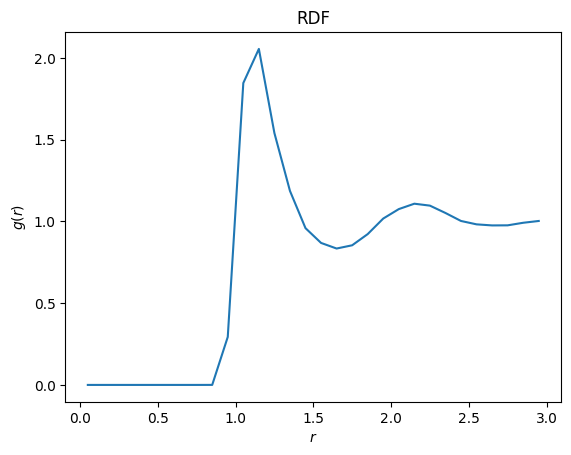
This looks like a typical radial distrbution function for a liquid!
Calculating the mean squared displacement
freud can also be used to compute the mean squared displacement of the particles. For this computation, we need to unwrap the particle positions, which we can also achieve using freud.
[16]:
import numpy

for i, snapshot in enumerate(dump_file):
    # allocate memory for whole trajectory on first pass
    if i == 0:
        positions = numpy.zeros((len(dump_file), snapshot.N, 3), dtype=float)

    # unwrap each snapshot using freud
    box = freud.box.Box.from_box(snapshot.box.to_hoomd_convention())
    positions[i] = box.unwrap(snapshot.position, snapshot.image)
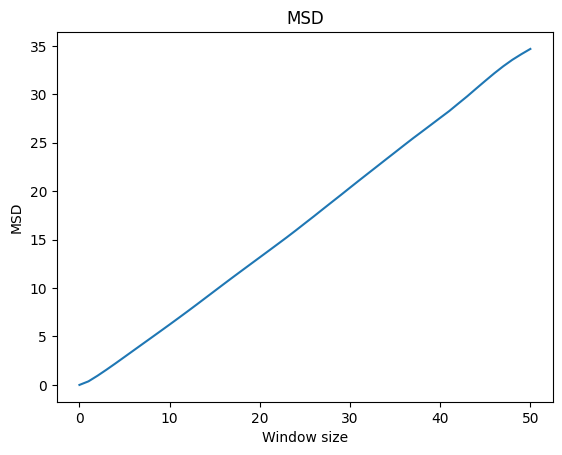
Now we can calculate the mean squared displacement and plot the result!
[ ]:
msd = freud.msd.MSD(box)
msd.compute(positions)
msd.plot();
plt.show();